
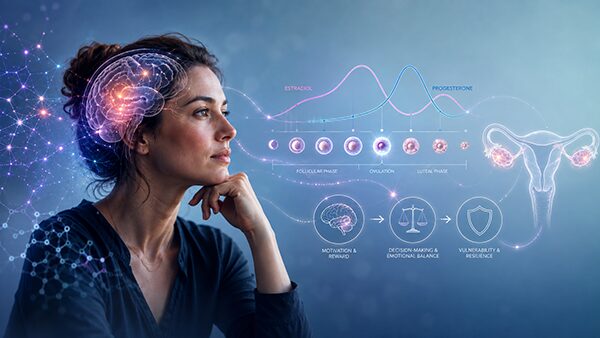
Rutgers researchers propose a new framework for understanding how changing hormone levels may influence reward, decision-making, and periods of vulnerability or resilience
Women can experience addiction differently than men, and those differences are shaped by a complex mix of social, environmental, psychological, and biological factors.
In a recent Hot Topics article in Neuropsychopharmacology, doctoral student Francesca M. LoFaro and Anna B. Konova, PhD, both affiliated with the Department of Psychiatry, Rutgers University Behavioral Health Care (UBHC), and the Rutgers Addiction Research Center within the Brain Health Institute (BHI), focus on one historically understudied contributor: the ovarian hormones estradiol and progesterone.
The researchers propose a computational framework for studying how fluctuations in these hormones may influence brain systems involved in reward, learning, decision-making, and motivation—and, in turn, contribute to changing periods of vulnerability or resilience related to substance use.
Importantly, the framework does not suggest that hormone levels directly determine substance use or relapse. Instead, it offers a way to study when certain addiction-related processes may become more or less influential within the same person over time.
Why Look at Ovarian Hormones?
Estradiol and progesterone fluctuate naturally across the menstrual cycle and also influence brain systems involved in cognition, emotion, motivation, and reward.
LoFaro and Konova focus particularly on estradiol’s interaction with dopamine, a neurotransmitter involved in reinforcement learning and reward.
One process of interest is reward prediction error—the brain’s response to the difference between what it expected to happen and what actually happened. These signals help shape future behavior.
Previous animal and human research suggests that estradiol may strengthen reward-related learning signals and increase sensitivity to rewards. In the context of addiction, this raises an important question: Could changing hormone levels alter how strongly someone responds to substance-related rewards or cues at different points in time?
From Hormones to Behavior
The framework links hormone-related changes in brain signaling with measurable cognitive processes, including:
- Reward sensitivity
- Cue reactivity
- Cognitive flexibility
- Risk tolerance
- Loss aversion
These processes may combine differently across individuals to create distinct patterns of vulnerability or resilience.
For example, higher estradiol states may strengthen reward-related signaling and sensitivity to rewarding cues, which could increase the motivational pull of substances in some individuals or circumstances.
Higher progesterone states may have a different, potentially buffering effect on some addiction-related processes.
These pathways remain hypotheses to be tested. The article does not show that a specific menstrual-cycle phase causes substance use or relapse.
Why Computational Modeling?
The same diagnosis can reflect very different underlying behavioral patterns.
One person may be especially sensitive to substance-related cues, while another may show greater risk-taking or difficulty adjusting behavior when circumstances change.
The researchers suggest combining repeated measurements of hormone levels, brain activity, and decision-making to better understand how these processes shift within the same individual over time.
The menstrual cycle offers a useful natural model because estradiol and progesterone change across relatively predictable periods.
Toward More Precise Treatment
If future research can reliably identify hormone-linked changes in specific neurocognitive processes, that information could someday help researchers better understand:
When to intervene — whether certain periods are associated with greater vulnerability for some individuals.
What to target — such as heightened cue reactivity, reward sensitivity, or changes in cognitive control.
Who may benefit most — recognizing that hormone-related patterns are unlikely to look the same for everyone.
Ultimately, the goal is not to divide women into broad categories based on menstrual-cycle phase. It is to better understand how vulnerability may change within an individual and what biological and cognitive processes may be contributing to those changes.
A Framework for Future Research
This article proposes a model for future research rather than reporting a new clinical trial or identifying a treatment recommendation.
Addiction vulnerability is influenced by many interacting factors, and ovarian hormones represent only one part of that larger picture.
Still, incorporating hormone dynamics into addiction research could help address an important gap and move the field toward more individualized, biologically informed prevention and treatment strategies.
Date: September 4, 2026
By: Ricki Arvesen